
The childcare app market is crowded and, honestly, pretty good. Brightwheel, Lillio (formerly HiMama), Procare, Kangarootime and others have spent years refining the daily-report-and-billing experience that daycare directors and parents want. If you run a standalone daycare that will only ever be a daycare, you have several strong options and it’s hard to go badly wrong.
This guide is for a different reader: the program or district where childcare is the front door, not the whole building. The organization that spans early learning into K-12, or wants to. Because for that reader, the standard childcare-app comparison misses the variable that matters most — what happens when the child turns five.
The trait every standalone childcare app shares
Brightwheel, Lillio, Procare, Kangarootime — for all their differences, they share one structural fact: they are early-learning platforms. Their world ends around pre-K or early elementary. That’s not a flaw; it’s their focus, and focus is why they’re good. But it means when a child ages out, the family ages out of the app, and the relationship either ends or gets handed to a completely separate K-12 tool where everyone starts over.
For a standalone daycare, that handoff is somebody else’s problem. For a program with elementary grades, a district running both pre-K and K-12, or a childcare center hoping to keep families as they grow, that handoff is the problem — and no amount of daily-report polish solves it.
The field, honestly
Brightwheel — Broad, well-liked, strong on daily reports, check-in/out, and billing. The default many programs land on. Our detailed head-to-head is Bloomz vs Brightwheel.
Lillio (formerly HiMama) — Strong on child development, documentation, and curriculum/assessment framing; popular with programs that emphasize the pedagogy of early learning.
Procare — A long-established, comprehensive childcare-management system, heavier on the business-operations and center-management side. Common in larger centers and chains.
Kangarootime — Center management with billing and family engagement, aimed at operational efficiency for multi-site programs.
All four are legitimate. If early learning is your entire scope, evaluate them on daily reports, billing fit, licensing support, and parent experience, and pick the one your teachers will actually use.
Where Bloomz is different
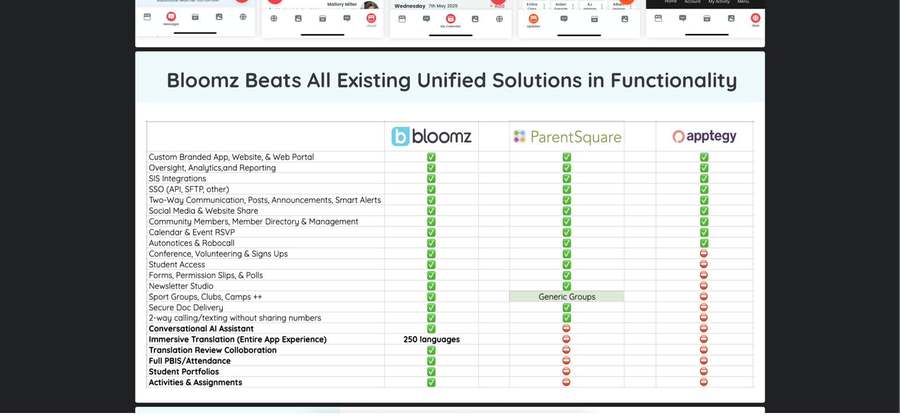
Bloomz is not trying to be a better daycare app in isolation. It’s built so the same family stays on one platform from a toddler room through twelfth-grade graduation. That means it has to do the childcare front door properly — custody-grade check-in and check-out, daily health screening, and immunization tracking against state requirements — and then keep going where the standalone apps stop.
The “keep going” is the point:
- Online registration and enrollment built in: a public web enrollment page in 250+ languages, SIS write-back (PowerSchool by API; other SIS by import file), sibling data reuse, fee waivers, and document upload with expiry tracking and immunization/CDC compliance checks — the same flow the family will use again at kindergarten and beyond.
- Recurring tuition, autopay, sibling plans, and subsidy-agency split billing for the childcare years, plus K-12 fees and teacher payment requests later — one billing relationship across the whole journey.
- Full-app immersive translation across 250+ languages, including right-to-left — the entire interface in the family’s home language, from the first drop-off onward.
- PBIS, House Points, SEL check-ins, and whole-child MTSS for the school years.
- Conferences with interpreter tracking, a school website engine with a built-in parent-facing AI assistant, and the rest of the machinery of running actual schools.
The family who checked their two-year-old in every morning is the same family getting behavior recognition in third grade and conference invitations in ninth — without ever switching apps or rebuilding their account.
How to choose
- Standalone daycare, no plans to span into school: pick the best pure childcare app for your workflow — Brightwheel, Lillio, Procare, or Kangarootime are all defensible. Don’t overbuy.
- Program with elementary grades, or a childcare that wants to grow families rather than hand them off: prioritize continuity. A platform that carries the family into K-12 keeps the relationship you worked to build.
- District running both early learning and K-12: a single platform across both means one login for families, one system for staff, and no lost relationship in the seam between pre-K and kindergarten.
- Serving many multilingual families: weigh translation depth heavily — full-app translation, not just translated daily reports.
The bottom line
The best childcare app for a standalone daycare is probably one of the established specialists. The best platform for a program that spans — or wants to span — early learning into school is the one that doesn’t make the family start over at age five. If continuity is your real requirement, that’s the lens to shop with. See how Bloomz serves childcare through 12th grade, or read the full Bloomz vs Brightwheel comparison.