In a K-12 school, morning drop-off is logistics. In a childcare or preschool program, it is a regulated event with real legal weight. Every morning a program has to record who physically handed the child over and when, confirm the child is well enough to stay, and — periodically — prove that every enrolled child’s immunizations are current, to a licensing inspector who can shut the program down if the records are not there. The front door of an early-learning program is a compliance surface, and the software that runs it has to treat it that way.
Most K-12 tools were never built for this. They assume attendance is a teacher tapping “present” on a roster. Childcare needs something closer to a chain-of-custody log with health and licensing baked in. Here is what that actually requires.
Check-in and check-out as a custody record
The core of childcare check-in is not attendance in the school sense. It is a record of who released the child and who received them, with a timestamp, every single day. Licensing depends on it, ratios depend on it, and in the worst-case moment — a custody dispute, an emergency evacuation, an unauthorized pickup attempt — it is the record that matters most.
That means the system has to know each child’s authorized pickup list, capture a signature or verified confirmation at both ends of the day, and produce ratio and roster counts a director can trust in real time. “Roughly who’s here” is a K-12 answer. Childcare needs “exactly who is here, who brought them, and who is cleared to take them home,” continuously.
Health screening at the door
Since COVID, daily health screening went from optional to expected in most programs, and it has stayed. A quick screen at drop-off — any symptoms, any fever, anything the program should know about today — protects a room full of young children who cannot advocate for their own health.
Done well, this is a few taps for the parent at check-in, logged automatically so the program has a dated record of every screening, with a clear path when a child does not clear it. Done badly, it is a paper clipboard that gets skipped on busy mornings and provides no record when someone asks for one. The value is in the logging as much as the screening: a program that can show it screened every child every day is a program that can answer a licensing question in seconds instead of an afternoon.
Immunization tracking that survives an audit
This is the compliance requirement that keeps directors up at night, and the one general tools handle worst. Every state mandates certain immunizations for enrollment, with specific exemption rules, and a licensing visit will check them. A program has to know, for every enrolled child: which vaccines are on file, which are due, which are overdue, and which children have valid exemptions.
The failure mode is a filing cabinet and a hope. The right tool tracks each child’s immunization record against the state requirements, flags what is missing or expiring before an inspector does, and lets staff pull a clean, current compliance report on demand. That is the difference between an audit that takes ten minutes and one that turns into a scramble through paper files while a licensor waits.
Bloomz Check-In is built for this early-learning reality: custody-grade check-in and check-out, daily health screening with a logged record, and immunization tracking against requirements with proactive flags for what is missing.
Why it should be the same platform, not a childcare silo
Here is the part that matters strategically for a district or a growing program. Families do not start at kindergarten. They start at a two-year-old room, or a preschool, or an after-school program. If those early-learning years run on a separate childcare app that the family abandons when the child ages into “real school,” you have thrown away the relationship at exactly the moment it was most established.
Keeping childcare check-in on the same platform the family uses through twelfth grade means one login, one app, one relationship across the entire journey. The parent who checked their toddler in every morning is the same parent getting PBIS recognition messages in third grade and conference invitations in ninth, without ever switching tools. And the billing follows: the same platform that handles the toddler’s tuition, autopay, and subsidy splits handles the high schooler’s fees.
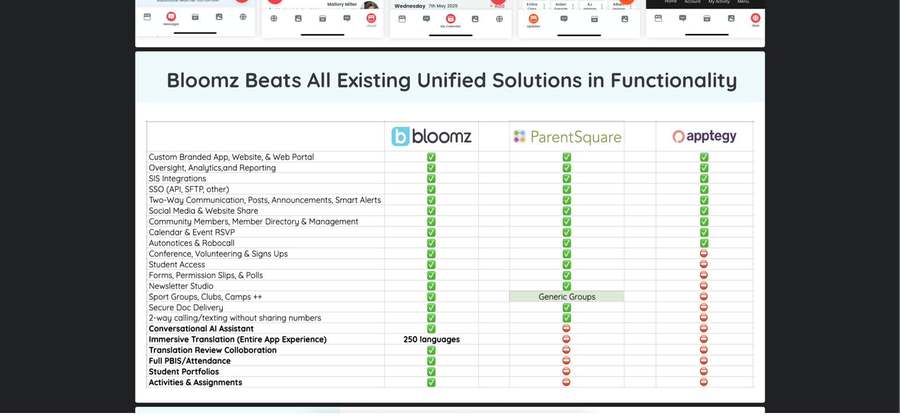
This is the whole premise behind serving childcare through twelfth grade on one system rather than handing families off from a childcare app to a K-12 app and losing them in the seam. We drew that comparison directly in Bloomz vs Brightwheel.
What to ask when you evaluate
- Does check-in capture who dropped off and picked up, with authorized-pickup lists — or just mark the child present?
- Is daily health screening logged with a dated record you can produce on demand?
- Does immunization tracking check against your state’s requirements and flag gaps before an audit?
- Can you produce a clean compliance report in minutes?
- Does the same platform carry the family forward into K-12, or does it stop at the childcare door?
Early-learning check-in is not a lighter version of K-12 attendance. It is a compliance-grade custody, health, and immunization record that happens to occur at drop-off. Run it on a tool built for it — and ideally on the tool the family will keep using for the next thirteen years. See Bloomz Check-In.