Online school enrollment was one of the clearer wins of edtech’s last decade. No more standing in a gym line with a folder of paperwork; register from your phone in an evening. But that win landed unevenly. For families who read and write English comfortably, online enrollment genuinely simplified a miserable process. For families who don’t, it often just moved the barrier — from a gym line where at least a bilingual staff member might be standing nearby, to a solitary screen full of English forms, legal language, and required-field errors nobody was there to explain.
Enrollment is the very first substantive interaction a family has with a school. If that first interaction says, implicitly, “this was not built for you,” everything after it starts from a deficit. Getting enrollment right for every family — including the ones who speak Somali, Pashto, Haitian Creole, or K’iche’ — is one of the highest-return equity moves a district can make. This is a look at what that actually requires, and how Bloomz enrollment is built to deliver it.
The translated-form trap
The common answer to multilingual enrollment is “we translated the forms,” and it is not enough, for a few reasons.
Static translations go stale and cover the wrong languages. A district translates its enrollment packet into the top five languages, prints them, and moves on. But the sixth language shows up next fall, the forms change the year after, and the translated versions drift out of sync with the English source. The family whose language wasn’t in the top five gets nothing.
A translated PDF isn’t a translated process. Even a perfectly translated form is a dead artifact if the surrounding experience — the portal navigation, the field labels, the error messages, the “your session has expired” warnings, the follow-up emails — stays in English. A parent can read the translated question and still be unable to navigate the system asking it.
Forms are where enrollment is hard, not where it’s easy. Enrollment forms ask for exactly the information that is most fraught for immigrant and refugee families: prior schooling records that may not exist in a US format, immunization histories from another country’s system, residency documentation, home-language surveys whose purpose isn’t explained. These are the fields where a family most needs support in their language, and they’re the fields a static translation serves worst.
How Bloomz enrollment is built
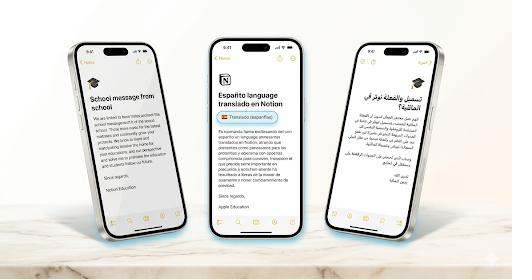
It translates the whole experience, not the message. The interface, the navigation, the field labels, the errors, the help text — all rendered in the family’s language, including right-to-left layouts for Arabic, Urdu, and Farsi. It’s the same full-app translation across 250+ languages that powers daily communication, applied to the front door — because translating the message body isn’t the same as translating the experience. Not a curated top five, but the long tail too.
It meets families where they are. Returning-family re-enrollment is close to one-tap, pre-filled from what the school already knows, so the annual update isn’t a fresh gauntlet. New-family enrollment asks for more, but guides rather than interrogates — explaining why each piece of information is needed, in the language the family reads. Under the hood it runs on the same forms engine families already use for everything else, so there’s no separate portal or second login.
It handles documents humanely. The immunization record, the proof of residency, the prior transcript — families submit these in a way that accommodates the reality that documents arrive in many formats and many languages, with a path to help when something doesn’t fit the expected mold. For early-learning and childcare programs, that connects directly to check-in, health, and immunization tracking, so the record a family submits at enrollment is the one the program relies on at drop-off.
It writes back to the system of record. Enrollment that ends in a pile of PDFs a registrar re-keys by hand introduces errors and delay. Bloomz enrollment writes back to the SIS: by API for PowerSchool, and by import file for other SIS. It flows through real integration, so the family’s effort and the school’s records stay in sync instead of diverging on day one.
The connection to everything after
Enrollment isn’t a standalone transaction; it’s the on-ramp to the whole relationship. The family that enrolls in their language should keep experiencing the school in their language — the daily communication, the conference invitations, the payment requests, all of it. When enrollment is a translated island bolted onto an otherwise-English system, the equity gained at registration evaporates by the second week of school.
That is the real argument for thinking about enrollment as part of a platform rather than a point tool: the language a family enrolls in should be the language they live in across every subsequent interaction, from the immunization reminder to the tenth-grade conference. The immersive translation that makes daily communication work — across 250+ languages — is exactly what enrollment needs, applied to the front door.
The standard to hold every vendor to
Enrollment is one of the last major school workflows that most platforms still handle as an English-first process with translation bolted on. The districts serving the most linguistically diverse communities feel this most acutely, and they’re right to push vendors on it. The bar worth holding out for is concrete: enrollment that renders the entire experience — not just the form text — in the family’s language, that guides rather than interrogates, that handles real-world documents humanely, and that writes cleanly back to the SIS so the family’s effort actually counts.
That’s the bar Bloomz enrollment is built to clear, and it’s the standard we’d tell any district to demand as they evaluate registration tools — ours included. If enrollment is the first thing a school says to a family, it should say it in a language the family understands. See how the same translation depth runs through everything after enrollment, from the immunization reminder to the tenth-grade conference — or see Bloomz enrollment itself.