
Almost every communication vendor selling to districts now has an AI story. The pitches land in two very different ways depending on who is in the room. Some leaders lean in, picturing staff finally freed from repetitive drafting and translation work. Others stiffen, picturing a system that messages families without a human reading it first, or that quietly makes judgments about a child. Both reactions are correct, and a good AI strategy honors both at once.
This guide is for the people who have to make that call: superintendents, communications directors, technology directors, and the cabinet members who sign off on what touches families. It does not cover every prompt and feature. It covers the line that matters, the questions to ask before you buy, and the privacy commitments you should refuse to compromise on. For a closer look at the specific tasks AI handles well versus the ones it should never own, read our companion piece on what AI should and shouldn’t do in school communication.
The line that matters: assistive versus autonomous
The single most useful distinction in school AI is between assistive and autonomous. Get this right and most other decisions follow.
Assistive AI helps a person do their job faster and stops there. It drafts a message a teacher then edits and sends. It translates a newsletter so a family can read it in their home language. It surfaces a pattern in attendance data so a counselor knows where to look. In every one of these cases, a human stays in the loop and a human makes the final call.
Autonomous AI acts on its own. It decides what to send, who to flag, or how to characterize a student, and it does so without a person signing off. That is a different thing entirely, and in a K-12 setting it is where the risk lives.
The reason the distinction matters so much in schools is that the stakes are not abstract. A clumsy autonomous message can frighten a family during an emergency. An automated judgment about a student can follow that child through their record. Educators carry professional responsibility for these moments, and software should support that responsibility rather than quietly assume it. This is the principle behind Bloomz AI (BLISS): the AI drafts, translates, and surfaces, and the educator decides.
Where AI earns its place
Used as an assistant, AI removes a real and growing burden. A few examples show the shape of it.
Drafting that a human finishes
Teachers and office staff write the same kinds of messages constantly: a field trip reminder, a note about a missing form, an update after an incident. AI can produce a clean first draft in seconds, matched to the right tone. The educator reads it, adjusts it, and sends it. The time saved is real, and nothing reaches a family that a person did not approve.
Translation that covers the whole experience
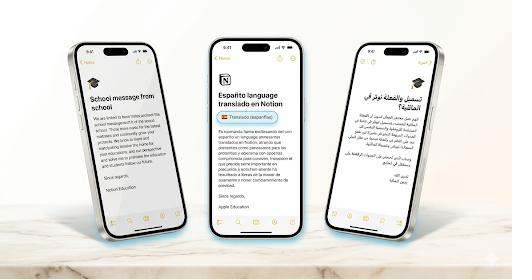
Reaching multilingual families is one of the strongest, safest uses of AI in communication. When translation is built in across the platform and not bolted on to message text alone, a parent can navigate the app, read announcements, and respond in their own language. Done well this widens access without asking staff to become translators.
Pattern surfacing that a person interprets
AI is good at noticing what humans miss in volume, such as a cluster of unread emergency alerts in one neighborhood or an attendance signal worth a second look. The right move is for the system to surface the pattern and hand it to a counselor or administrator, who then decides what, if anything, to do. The judgment stays human.
Where AI should not go
Just as important is naming the places AI should be kept out of. These are not edge cases. They are the lines that protect students and the relationship between schools and families.
No autonomous messaging to families. AI should never send a message to a parent that no staff member has read and approved, full stop. The convenience is not worth a single frightening or inaccurate message landing in a household with no human behind it.
No determinations about students. AI should not decide a child’s behavior label, risk level, or consequence. It can organize information for the educator who makes that call. It should not make the call.
No selling, training on, or exposing student data. Family and student information is not raw material for someone else’s model or ad business. A vendor that is vague about this has told you what you need to know.
How to evaluate a vendor’s AI claims
When a vendor says they use AI, the marketing rarely answers the questions that actually protect your district. Bring these to the table.
Does a human approve anything that reaches a family? If the answer is no, or if it takes the salesperson a while to get there, treat it as a finding.
What does the AI decide entirely on its own? You want a short, specific list. Vague reassurance is not an answer. Anything on that list touching students or family messaging deserves scrutiny.
Where does the data go, and who can see it? Ask whether student data is used to train models, whether it is shared with third parties, and where it is stored. Ask it plainly and get it in writing.
Can you turn it off? Real control means you can disable AI features at the district or building level and keep using the platform. If AI is load-bearing and cannot be switched off, you have less control than you think.
The student-data-privacy questions underneath all of it
AI sharpens privacy questions that were always there. Confirm the basics regardless of the AI conversation: FERPA and COPPA compliance, a signed data privacy agreement, and hosting on SOC 2-certified cloud infrastructure. Then press on the AI-specific edges. Is student data ever used to improve the vendor’s models? Is anything sent to an outside AI provider, and under what terms? Who at the vendor can access family data, and is that access logged? A vendor confident in its practices will answer these without flinching.
AI in school communication is worth having when it stays in its lane: drafting that a person finishes, translation that opens access, patterns that a human interprets. Keep it out of autonomous messaging and student determinations, demand clear answers on data, and insist you can turn it off. Get those guardrails right and the technology becomes a quiet help rather than a risk you have to manage. To see how an assistive, educator-controlled approach works in practice, Schedule a demo.